The Lost Art of Boredom & Internal Rebellion in an Attention Economy
So today I learned the proper spelling of Tchotchke. In the past, when I spelled it, I did so phonetically: “Chochky, Chauchkey, Chatchki,” etc. The spelling and its historical roots are more interesting than I had thought. I would’ve bet on the phrase being Yiddish even before looking it up, but I didn’t know it had Slavic origins. It comes from the word for Trinket in many Slavic languages. Tsatska in Russian, Tsiatska in Ukrainian, and Cacko in Polish. I had known prior that Yiddish was a fusional Germanic-Semitic Language; however, I did not know that it had a large influence from the Slavic languages as well. That’s pretty neat.
So what? For those who don’t enjoy a bit of armchair linguistics, the above is probably some dull and rather uninteresting information. The point of my amusing tchotchke discovery is that, in the middle of checking whether I was spelling a word right, I found some joy in the rote banality of everyday texts and emails by taking an extra 5 minutes before replying to learn a bit of the fascinating, meaningful history behind the word. The point here is those 5 minutes. The suspension of immediate concerns in the middle of the day to indulge in some whimsical curiosity.

A lot is going on in the world today. A lot of it is unpleasant and frustrating at best, malicious and devious at worst. Many people, myself included, have had or felt their jobs threatened by emerging technologies and general political-economic disarray. It can seem like a stressful time to be living in. The news, at times, can seem geared to cultivate feelings of anger and outrage in us. These feelings are often well justified. Often they are not. If the news may trim the details of the extenuating circumstances of the everyday horror, social media seems to treat extenuating circumstances with the same veracity as Bigfoot. Where does this leave us? What to do in this time of social, political, technological, and economic change?
We need to sit alone and do nothing.
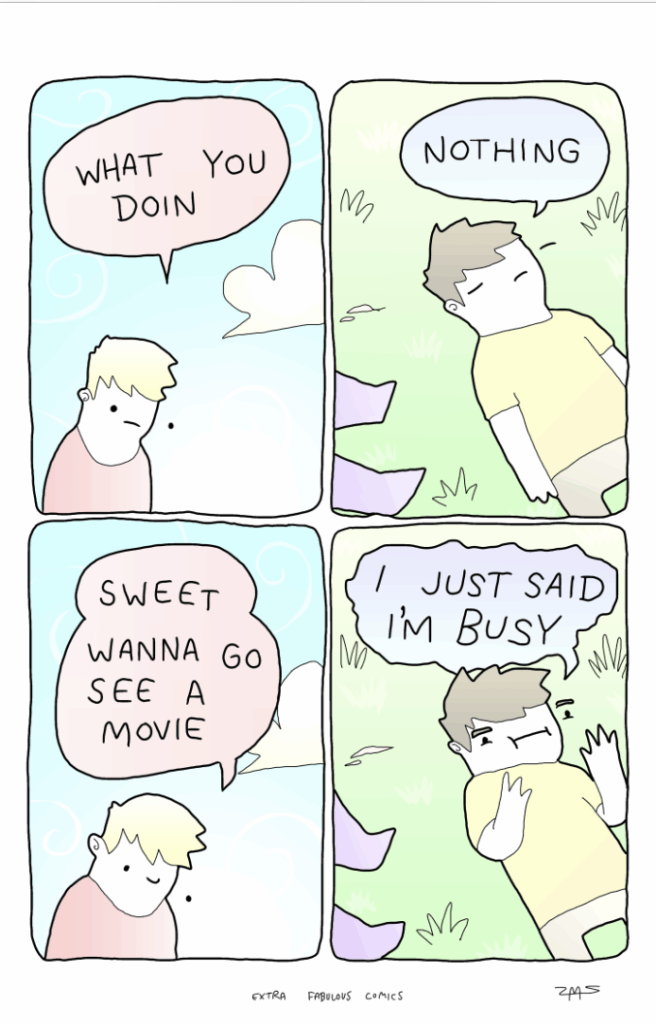
Now, do not read that as an invitation to non-action. Because I cook, doesn’t mean I don’t eat. Doing nothing for periods enhances rather than inhibits doing something later. Most of us in the modern world are not taking the time to properly cultivate boredom. I should also mention I am not talking about mediation, in the sense that it is now known in most of the West. What I invite all of us to do is sit still, by yourself, without a phone, a book, or a computer. There should be no music, don’t focus on your breath, don’t watch the clock, or look at a candle, no prayer, no mantras. In the most literal sense, I want you to sit alone and do nothing for 30 minutes at a minimum. Let the mind take you where it will, if you fall asleep, fall asleep. Just stay still and do nothing.
Why? For the science folks, I could talk about activation of the Default Mode Network in the brain, creating space for the consolidation of memories and experiences, yada yada. In short, I think of it as “Cultivating boredom”.
Get disinterested. The modern world is bright and shiny, and in the last decade or so, your attention has become more and more a mineable resource for companies. We switch from task to task, project to project, activity to activity. The pace of modern life has increased both at work and at home. From sunup to sundown, most people are doing “something”. We are not taking the time to be bored every day ― because the modern world is so shiny and fast-paced we have to actually make the time to be truly bored. By not making space for our boredom, by not cultivating run-of-the-mill blasé, not tending our gardens of small sadness and petty frustrations, we end up truly depressed, profoundly frustrated by daily interactions and news stories. Many of us never let our minds settle anymore. We internalize the hectic pace of modern life and adopt the rat-race approach to our own interior lives.
In the last 10 years, I have seen more and more people, myself included at many points, jumping from thing to thing, topic to topic, image to image, people experiencing a strong sense of self-assuredness which is many times out of place, while inside often feeling profoundly restless and empty, overwhelmed with imposter syndrome. We end up feeling like a chocolate Kinder Egg, rich and exuberant on the outside, concealing a profound hollowness. I don’t think there is a catch-all solution for these problems. I can’t guarantee that sitting and doing absolutely nothing for 20 mins – 1hr a day will help. But it is something that most of us haven’t tried yet. I have found wonderful benefits. For the last 2 years, for 40 minutes at a time, once or twice a day, I sit or lie down and do nothing. The benefits have been greater than I had ever hoped.
I am not asking you to meditate. No focus is needed. I am not imploring you to “know thyself” I am merely asking you to do the simplest thing possible. Sit/stand/lie still for 30 mins, no entertainment of any kind other than your own mind, and just be. This is how we can reclaim a bit of our minds, how to begin to be on good terms with ourselves. Independent of our place in the world. If the emotions are a garden, these periods of calculated boredom and mundane mind wandering are how we tend to the weeds. If our attention and sense of choice are a blade, these periods of dull musings and lackluster nothings are the whetstone with which we can sharpen our minds.
I can make no promises, but I suspect if you begin in earnest to practice being bored, unenthused, and dull, within a few weeks the world seems a bit brighter. Everything has a new shine you haven’t felt in a long time. If you keep practicing, you might experience the workers paradox that by moving slower your work is being finished faster, you might regain awareness of your sense of choice, your agency, in everyday situations. There is no way to escape the external rat race, but with effort, you can rebel internally. Find a little freedom in the chaos, discover the breathing room that the economy of attention has worked so hard to hide from us over the last 20 years. With a growing whimsical childish curiosity, your mood will improve, and with time, maybe you’ll indulge in what was for so long overlooked, see the beauty in the little things, and find joy in discovering your daily tchotchke.